


Revolution in Urban Mobility in Greater Florianópolis
Mobility is one of the fundamental pillars of urban development in any modern city, and Greater Florianópolis is now preparing for a revolution in its transportation system. An ambitious modernization plan! Driven by investments from the World Bank, it foresees the implementation of an integrated, multimodal public transportation model, with execution expected over the next five years.
The proposal represents the pinnacle of intelligence and strategy for improving the infrastructure of the Florianópolis region, promising long-lasting solutions focused on the user experience. With this, the aim is not only to facilitate the daily commutes of the population, but also to reorganize the urban dynamic in a more efficient and environmentally responsible way.

What changes with the new mobility plan for Greater Florianópolis?
First and foremost, the project encompasses a complete overhaul of the public transportation system, focusing on integration and operational efficiency. The initiative ranges from creating exclusive bus lanes to adopting unified fare systems across the municipalities.
Furthermore, the proposal for intermodality stands out, allowing citizens to use different means of transportation on a single trip. Combining, for example, waterborne transport with electric buses and even public bicycles. In other words, there will be a broader range of alternatives, tailored to the needs and profile of each journey.
In this sense, the goal is to transform urban mobility into an accessible, agile service aligned with today's modern principles. As a result, a reduction in traffic congestion, improved air quality, and a new logic of territorial occupation are expected.

How will the integrated multimodal public transportation system be implemented?
Initially, implementation will take place in phases, prioritizing public transportation infrastructure. This includes the creation of exclusive bus lanes, integration stations, connected bike lanes, and transfer points that facilitate switching between modes quickly and comfortably.
Subsequently, the unification of the fare system across the different municipalities of the metropolitan region will be promoted, following the model of other international cities.
This measure aims to eliminate barriers between cities. In other words, it will allow passengers to use a single fare to complete the entire journey, even when it involves different modes of transport.
Simultaneously, the plan calls for the incorporation of technologies for real-time monitoring of routes, making it easier for users to plan their journeys. Apps, digital displays, and geolocation systems will be essential tools for ensuring a smooth service.
What modes of transport are planned, and how do they connect?
The plan includes a diverse range of modes, each with a strategic role within the mobility ecosystem:
Electric buses
They will be the main axis of public transportation, operating in exclusive lanes to ensure punctuality and reliability. In addition, these vehicles represent a less polluting and quieter alternative.
Waterborne transport
It will be reintroduced as an alternative for coastal regions, connecting neighborhoods and municipalities through vessels with schedules synchronized with the other modes.
Public bicycles
Integrated with transportation stations, they will facilitate access to public transportation for short trips or as a last-mile complement.
Integrated fares and logistics
All these modes will be interconnected through a smart ticketing platform. This will allow passengers to move easily between buses, bicycles, and boats, paying just one unified fare.
In other words, the multimodal system will seek to meet the different realities and preferences of the population. Without prioritizing any specific mode, but instead promoting synergy among all of them.

Who will manage the new mobility system?
The system will be managed by an intermunicipal consortium, which will act in coordination to align the interests of the cities of Greater Florianópolis. This shared governance is considered essential to ensure uniformity in public policies and the efficiency of services.
After the initial phase of public investment, with significant support from the World Bank, operation of the system will be transferred to the private sector. This concession model aims to attract specialized companies and encourage healthy competition, which, according to planners, will result in improved service quality and lower fares.
On the other hand, this transition will require rigorous regulation and oversight mechanisms to ensure that the interests of the population continue to be prioritized over time.

What benefits to mobility in Greater Florianópolis are expected for the population?
Above all, the main benefit will be a significant improvement in the quality of life of residents of the metropolitan region. With a more efficient, faster, and integrated system, the time spent on commutes should be considerably reduced, positively impacting productivity and daily well-being.
In addition, easier access to public transportation will encourage its use, reducing dependence on private vehicles. As a consequence, a reduction in pollutant emissions, lower urban noise, and more public spaces available for pedestrians and cyclists are expected.
Likewise, the inclusion of bicycles and waterborne transport will expand travel options in areas that are currently underserved, promoting greater territorial equity and social integration.
Additionally, the integrated fare is likely to reduce costs for those who need to travel long distances or cross different municipalities, especially benefiting lower-income segments of the population.
How will the population be able to take part in the process?
First and foremost, the plan will be submitted to public hearings, where society can share opinions, suggest adjustments, and understand the implementation stages. This active participation is considered an important pillar of the project, since urban mobility must reflect the real needs of the population.
Projects of this scale frequently face challenges related to social acceptance, route reorganization, and the transition period between old and new systems. For this very reason, transparency and ongoing dialogue with the community will be fundamental to the success of the initiative.
In short, this is a historic opportunity for the citizens of Greater Florianópolis to contribute to building a new logic of urban mobility: more efficient, inclusive, and long-lasting.
For more information: the official SUDESC website offers the Plano de Mobilidade Urbana Sustentável da Grande Florianópolis (PLAMUS). It includes various reports, diagnostics, and proposals, including studies that will serve as the basis for changes in public transportation in the region.
👉 https://www.sudesc.sc.gov.br/plano-de-mobilidade-urbana-sustentavel-da-grande-florianopolis-plamus/
How will the North region of the Island be impacted?
The North of the Island – with highlights such as Jurerê, Canasvieiras, Ingleses and Ponta das Canas – will be one of the most benefited by the new intermodal logic. The connections between the North of the Island and the Centro will be modernized through electric buses running on exclusive corridors.
In addition, studies are underway to reactivate waterborne transport points, especially during high season, enabling travel by sea between areas such as Canasvieiras and the city center. This will ease land traffic and offer tourists and residents an agile and sustainable alternative.


How will the plan affect the East side of the Island?
The East side of the island, with a focus on the Lagoa da Conceição, Praia Mole and Joaquina regions, will receive new bike lanes connected to the bus system and integration stations. As an area known for eco-tourism and sports tourism, encouraging the use of bicycles and sustainable public transportation will be a priority.
Although waterborne transport is not expected to serve the East side directly, quick connections via electric bus to the central area and Beira-Mar terminals will enable more efficient access to the multimodal system.


What impacts will occur in the South region of the Island?
The South Region – including neighborhoods such as Campeche, Ribeirão da Ilha and Pântano do Sul – will be gradually incorporated into the new system, with emphasis on priority bus lanes and terminals that will connect the region to the rest of the Island and the mainland.
Connections to waterborne transport are also under review, particularly around Ribeirão da Ilha, where port structures already exist. The potential creation of a maritime terminal in the South could open new routes to the Center, easing vehicle traffic on SC-405.


How will the Central region of the Island benefit?
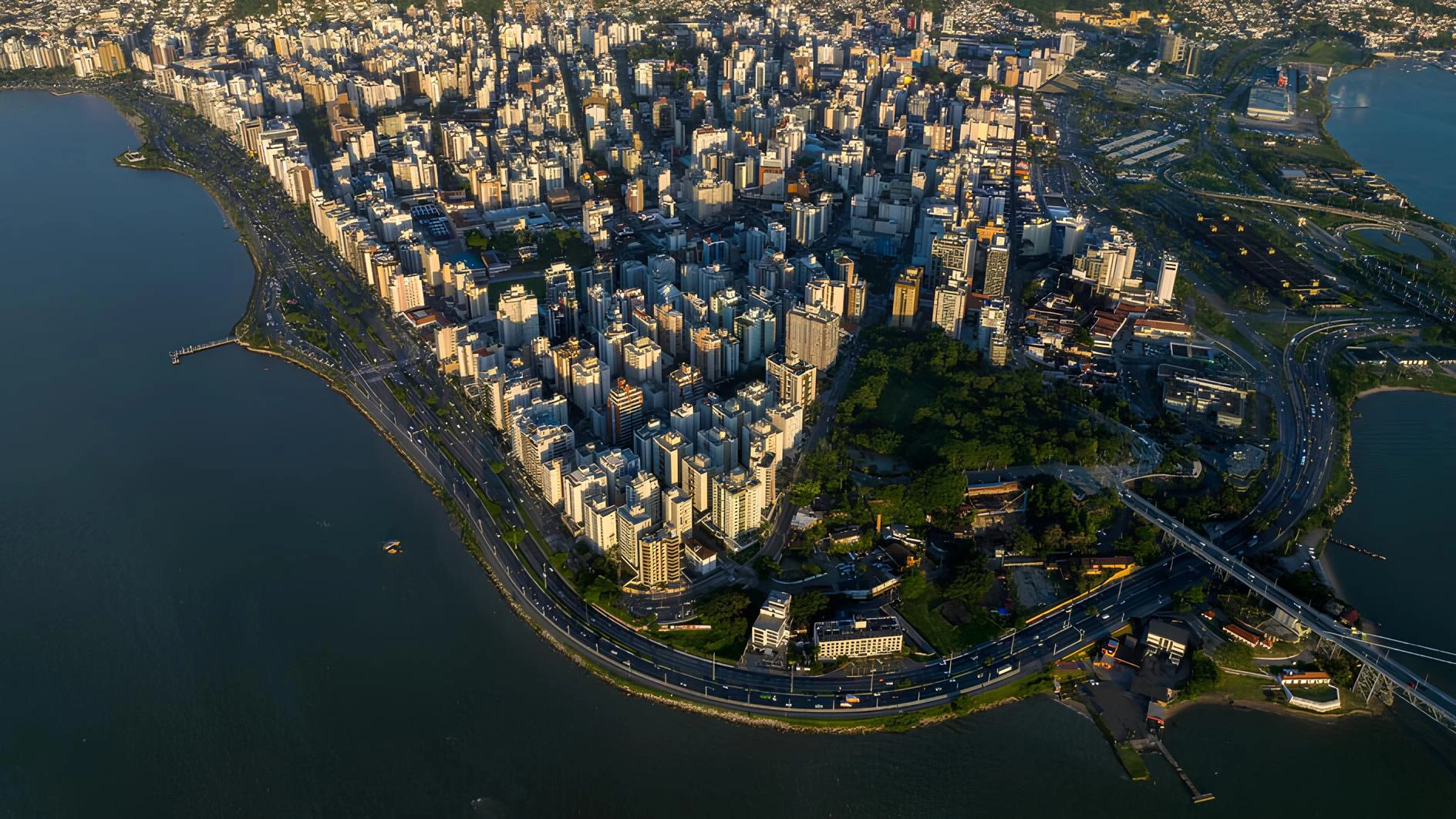
Downtown Florianópolis will serve as the central hub for integrating all modes of transportation: buses, bicycles, waterborne transit, and intermunicipal systems. The redevelopment of urban terminals and the creation of nautical stations will enable maritime connections to neighborhoods in the North and even to cities such as São José and Biguaçu.
Furthermore, the Centro will operate as hub logistics of regional mobility, with synchronized schedules and integrated ticketing. As a result, the flow between the central neighborhoods and the other municipalities will be smoother, more agile, and more accessible.


- Agronômica
- Armação da Piedade
- Balneário Estreito
- Barra da Lagoa
- Beira-Mar Norte
- Cachoeira do Bom Jesus
- Cacupé
- Campeche
- Canasvieiras
- Canto da Lagoa
- center
- Coqueiros
- Córrego Grande
- Ingleses
- Itacorubi
- João Paulo
- Jurerê Internacional
- Lagoa da Conceição
- Morro das Pedras
- New Campeche
- Praia Brava
- Praia Mole
- Rats
- Rio Tavares
- Saco Grande
- Santo Antônio de Lisboa
- Trindade
Qual será o papel da área Continental da capital?
The Continental area of Florianópolis – which includes neighborhoods such as Coqueiros, Estreito and Itaguaçu – will be crucial in the connecting axis between the Island and the mainland. The region will have bus corridors that will feed the waterway and road systems, making it a multimodal transfer hub.
Waterborne transit may feature stations near Estreito and Coqueiros, connecting to the Center of the Island by sea and easing traffic on the Ponte Pedro Ivo. In addition, access to public bicycles and electric buses will complete the mobility network for residents of this region.
What impacts will be felt in the other areas of Greater Florianópolis?
The implementation of the new mobility plan will bring direct and structural impacts to all municipalities in Grande Florianópolis.
- São José, given its strategic location and population density, will be one of the main beneficiaries of exclusive bus lanes, integration stations and connections to waterborne transport. The municipality will function as the central link between the Island and the other cities in the region.
- Palhoça, which is experiencing rapid urban expansion, will receive investments in express bus corridors and integrated bike lanes. Low-income residents will be especially benefited by the fare integration, reducing the cost of intermunicipal trips.
- Biguaçu, with its privileged logistics position and access to Baía Norte, is expected to host transshipment structures linked to maritime transport. This will open new travel routes to the Center of the Island, offering alternatives to the heavy traffic on the highways.
- Santo Amaro da Imperatriz, although farther from the urban core, will be connected to the system through express bus lines and fare integration. Improved access to jobs, healthcare, and education will be one of the main advantages for residents.
- Antônio Carlos, on the other hand, will benefit from improvements in regional public transportation, with new connections to the Biguaçu and São José terminals. Although the initial impact may be more modest, the plan foresees the gradual integration of the municipality into land routes and, in the future, even into the waterborne system, through intermodal connections.
In short, the new system will reorganize the entire logic of metropolitan mobility, creating an efficient, continuous, and inclusive network in which each municipality will play a complementary role and enjoy expanded access to urban opportunities.
In conclusion,
Finally, the new mobility plan for Greater Florianópolis marks a historic turning point in how the region is structured, connected, and moved. By proposing a truly integrated multimodal system, combining waterborne transport, electric buses in dedicated lanes, public bicycles, and unified ticketing, the project not only resolves long-standing bottlenecks. It also envisions a modern, cosmopolitan city model that is more accessible, efficient, and environmentally responsible.
Accordingly, the impacts will be concretely felt across all metropolitan microregions and in every quadrant of Ilha de Santa Catarina. Municipalities such as São José, Palhoça, Biguaçu, Santo Amaro da Imperatriz, and Antônio Carlos will enjoy faster, fairer, and more functional connections with the capital.
At the same time, neighborhoods in the North, South, East and Central areas of the Island will have their internal and external flows rationally reorganized, with emphasis on the strategic reactivation of maritime transport as a vector of mobility and traffic decongestion.
In other words, the plan goes beyond improving transportation; it represents a profound reconfiguration of urban life. It expands access to opportunities, enhances property values across neighborhoods, redistributes population flows, and restores public space as an instrument of social integration and territorial development.
Therefore, as the projects move off the drawing board, public hearings are held and the infrastructure begins to take shape, it will be essential for civil society to follow, participate in and actively contribute to this process. Only through engagement, transparency and a collective vision will it be possible to establish a new paradigm of mobility, one capable of meeting the demands of the present and preparing our beloved region for the future.

We are Luxury Home Floripa, a real estate agency specializing in the sale of luxury properties in Florianópolis. For living and investing.
Count on our brokers and our specialized real estate advisors to find the perfect property and guarantee your peaceful living in [location]. Florianópolis. Our team operates with the concept of a Boutique of Service, offering a highly personalized and bilingual experience.
We are executives who are knowledgeable not only about the characteristics of the properties, but also about the different lifestyles and particularities of each region of Florianópolis Island. For those arriving in the city and wishing to visualize what it would be like to live here, our selection goes beyond location and square footage.
We select properties that perfectly fit your current life stage, considering aspects such as your routine with children, suggestions for schools, sports, businesses, special activities, and the dynamics of each neighborhood — always with a sensitive eye to your needs and preferences. In other words, from the search to the negotiation, we are by your side every step of the way.
With our experience and extensive knowledge of the region, we will find the ideal place for you to live and invest. We are located in Jurerê Internacional, at Professor Heinz Braunsperger Street, 88 – Store 3. Schedule your visit.

♠ +55 48 99660 6799
♠ dayrocco@luxuryhomefloripa.com.br
♠ Follow on Instagram
♠ Check out our Real Estate Portfolio

I am a specialist in luxury real estate, high-end properties, and real estate investments in Southern Brazil. Recognized for my premium and bilingual service, I accompany each client from the initial search to the delivery of the keys, connecting buyers and investors to the most exclusive developments on the island, from Jurerê Internacional to Campeche, passing through Cacupé, João Paulo, and Praia Brava. Founder of Luxury Home Floripa, I have accumulated over R$320 million in sales over five years of experience in the high-end real estate market. Here I share analyses of the luxury market in Florianópolis, high-end launches, appreciation trends, and everything a discerning buyer needs to know before making a significant asset decision. I also share insights and news about the lifestyle surrounding this universe: the nautical world, gastronomy, events, sports, and everything that connects Florianópolis to the world of high-end real estate.